Vol. I · Issue No. 01
November 2026 · Page V
Section 04 · Design
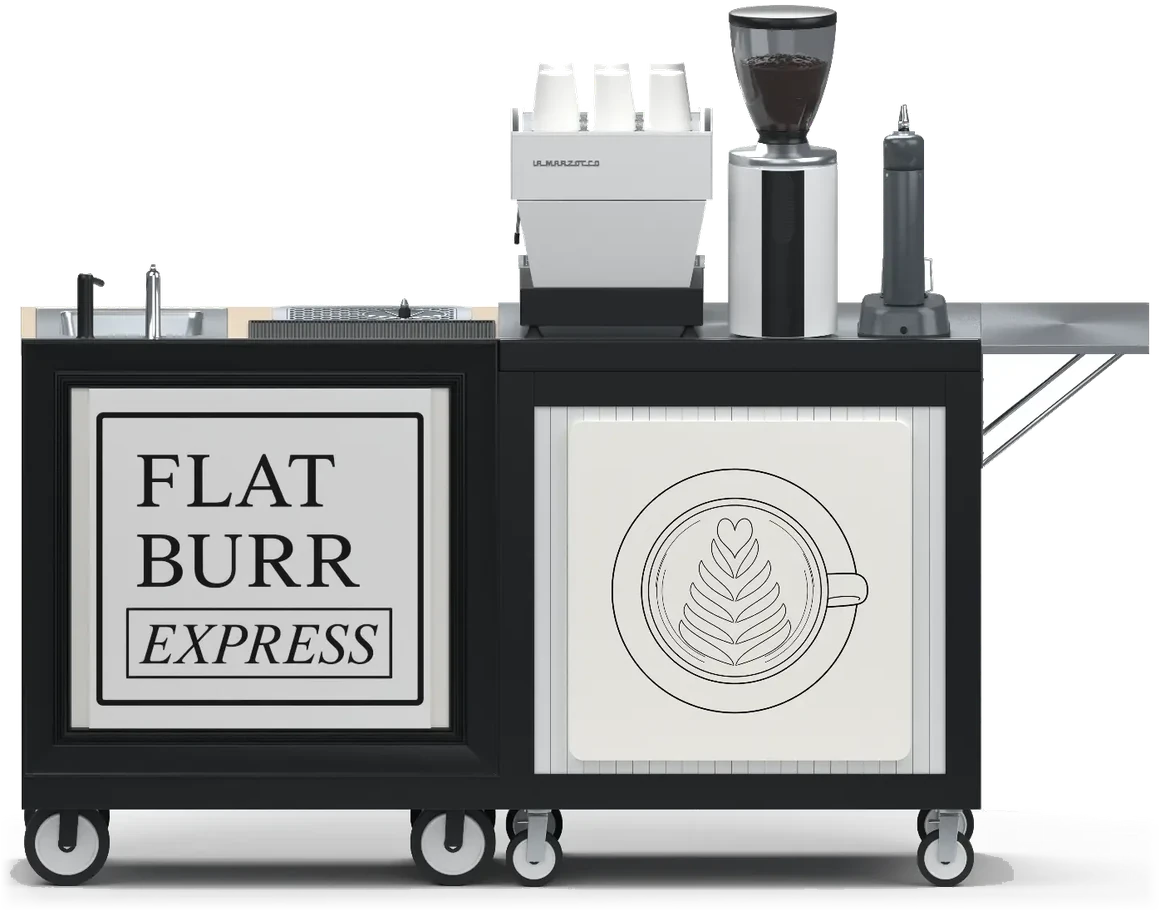
A modular design, styled for your event.
Every panel, shelf, and sign swaps in and out, so the cart can take on a look that fits your day.
Every booking uses the Flat Burr Express cart.
Book this setupThe Cup
Flavor profile.
Explore how straight espresso can move from lively and fruit-led to rich and roast-led. These are Flat Burr flavor directions—not quality grades or an industry standard.
Centered selected. A centered expression.

Centered
A centered expression.
Neither fruit-led acidity nor roast-led depth dominates. Moderate acidity, fruit character, body, and roast character share the cup.
Common sensory families
Fruit · Caramel · Cocoa
Expected expression
Segment count is a qualitative expression — not an amount, a quality grade, or a measurement. The words are the meaning.
Balance can live anywhere on the line
A brighter, centered, or deeper espresso can all be well balanced. We think about balance through sweetness, integration, and a clean finish — without harsh bitterness or drying astringency.
What shapes the direction
The one clear direction
Roast & development
EvidenceStrongest
Lighter or shorter-but-fully-developed roasts generally present brighter; deeper or longer roasts generally present deeper. This is not strictly monotonic — an intermediate roast can present acidity more clearly than the lightest when underdevelopment or astringency masks it.
Also shapes the cup
These change how an espresso tastes, but the evidence doesn’t show a reliable push toward Bright or Deep.
Extraction
important espresso modifier
Extraction changes how acidity, body, bitterness, and astringency present. Underextracted sourness is not desirable brightness, and no single ratio, temperature, time, pressure, or grind has a universal Bright-to-Deep direction.
Green-coffee potential
important, but metadata is not deterministic
Origin, variety, and relative altitude can shape available acidity, aroma, and body, but they arrive correlated and must not create country or cultivar rules.
Processing
stronger for character and body than for a fixed direction
Washed is often described as clean or clear; natural as fruity, sweet, boozy, or full; experimental processing as intense and polarizing. No stable espresso acidity order emerged.
Water
conditional tuning influence
Alkalinity can change how acidity is perceived, but espresso reports conflict and the evidence does not establish a portable effect magnitude.
Green age
limited directional evidence
Storage research supports quality decline over time more clearly than a reliable move toward Deep.
Interactions
the factors do not act independently
Roast can reveal or mask green potential, and roast, processing, extraction, and water can change one another’s expression.
These labels describe how consistent the evidence is for a broad direction. They are not measured effect sizes, weights, or rankings.
How we built this view
This version combines controlled published research (Tier A), industry-technical work (Tier B), and repeated practitioner reports (Tier C). Individual anecdotes (Tier D) illustrate variation or dissent and do not establish a general rule on their own. Roast direction has the clearest convergence. Extraction is important but recipe- and coffee-dependent. Evidence for origin, variety, altitude, processing, water, and age is more conditional, and some findings come from cupping, filter, immersion, or Turkish coffee rather than espresso. This is an evidence-informed educational model for straight, mostly-Arabica espresso — not a prediction for every coffee, a quality rating, or an industry standard. No Flat Burr production-shot test data is used in this version.
Reference interpretation: straight espresso, generally 1:2–1:2.5, 91–95°C, 25–32 seconds, using a commercial grinder. Brightness should not be confused with underextraction, and depth should not be confused with harsh bitterness.